
Overview
Factory Host Agent has two primary runtime parts:
-
an Ignition Gateway module that manages enrollment, status, tags, commands, and administration
-
a Host Client that runs on a participating Linux, Windows, or macOS host.
The Host Client initiates communication with the Gateway. After trust approval, it supplies current host information and accepts only operations allowed by active host-side mappings.
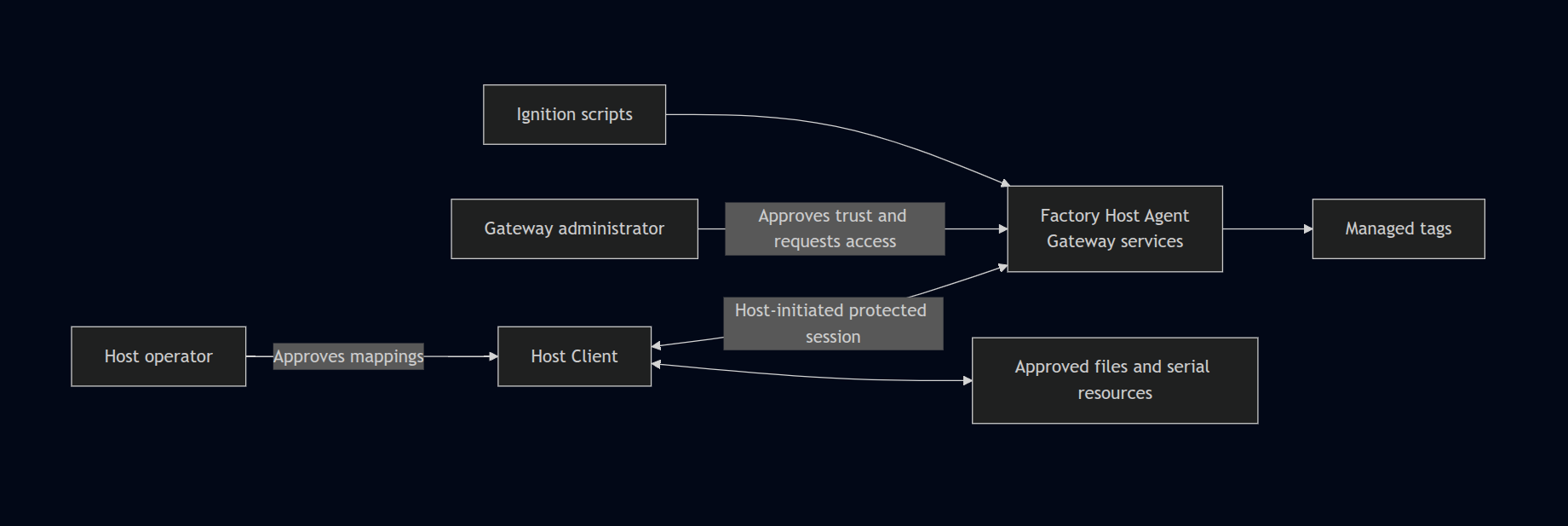
Ignition Scope Distribution
Gateway Scope
The Gateway scope contains the main module functionality:
-
Host Client enrollment and trust administration
-
Gateway configuration and installer pages
-
connection and lifecycle management
-
current telemetry and operational status
-
permission requests
-
activity, command, and transfer tracking
-
the managed tag provider
-
serial desired configuration
-
the Gateway implementation of the public file-scripting functions.
Current operational history is primarily memory-resident. Trust, enrollment metadata, selected settings, serial desired configuration, and security identity material persist across module restarts.
Designer Scope
Designer scope provides access to the public system.hostagent.file scripting functions.
Client / Vision Scope
Vision client scope provides access to the public system.hostagent.file scripting functions.
Perspective Session Scope
Perspective projects can consume the module's tags through normal Ignition tag features, subject to the project's design and permissions.
Major Functional Areas
Enrollment and Trust
A Gateway-generated setup bundle supplies the Host Client with enrollment configuration. The client first appears as pending. Administrator approval establishes it as a trusted participant.
Monitoring and Projection
The Host Client reports current host and process observations. The Gateway displays this information and projects it into managed tags.
Resource Authorization
Host enrollment and resource authorization are independent. Active mappings determine which filesystem and serial resources are visible and whether modifications are allowed.
Commands and Results
Gateway pages, tags, and scripts can request approved work. Submission, acknowledgement, and completed result are distinct stages. Users should confirm final state rather than treating successful dispatch as completion.
Data Flow
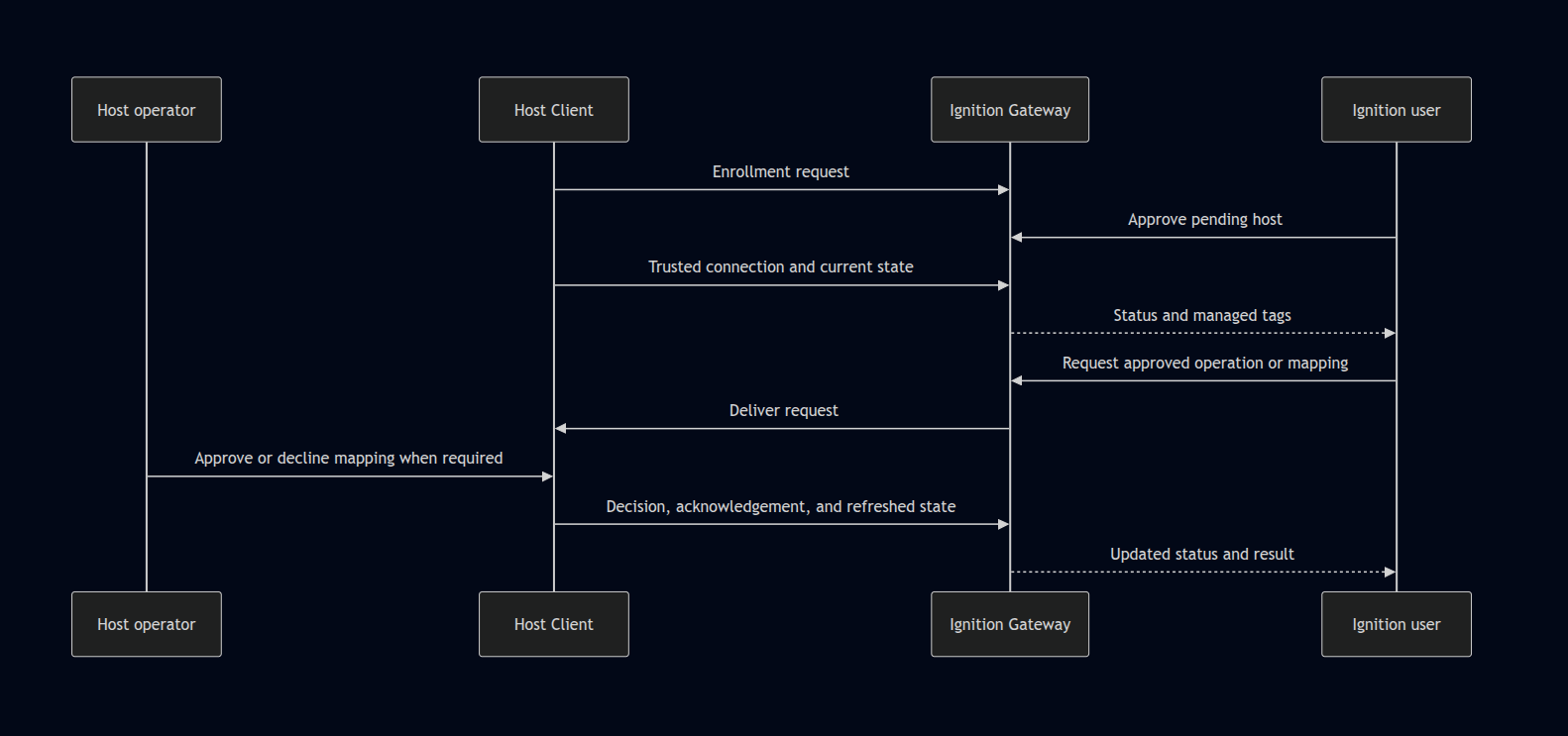
Lifecycle
-
The module starts and restores durable Gateway-owned state.
-
The Host Client is provisioned with a setup bundle.
-
The host operator starts the Gateway service in the Host Client.
-
The client enrolls and appears as pending.
-
A Gateway administrator approves the host.
-
The trusted Host Client publishes current state and accepts mapped operations.
-
A running client retries ordinary disconnections and republishes state after reconnect.
-
Module restart clears most live operational state; reconnecting clients rebuild it.
-
Stopping the Host Client ends the live session and serial connections but preserves its local identity and approved mappings.
External Dependencies
Administrator-relevant dependencies are:
-
the Ignition Gateway platform
-
the platform-specific Host Client package
-
outbound network reachability from the host to the Gateway URL
-
operating-system telemetry facilities
-
local filesystem and serial-device access granted to the Host Client process
-
operating-system certificate trust when protected WebSocket transport is used.